The $30–70M Hiding in Your Medicare Population
I’ve spent 20 years in value-based care, running operations, building care management programs, staring at risk adjustment reports. And I can tell you with confidence that the single largest revenue gap in most Medicare populations isn’t a coding problem or a documentation problem.
It’s a diagnosis problem. And it’s hiding in plain sight.
The math nobody wants to do
Approximately 15% of your Medicare beneficiaries age 65 and older have some form of cognitive impairment or dementia. That’s the Alzheimer’s Association’s number, confirmed across multiple epidemiological studies.
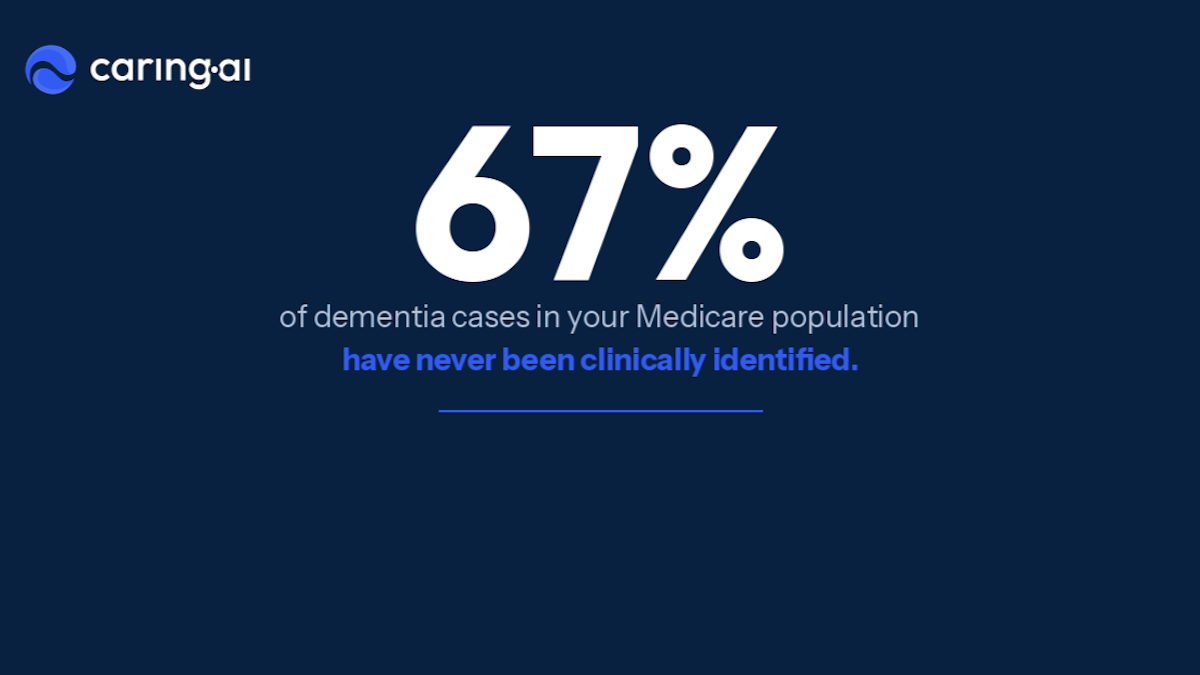
Now here’s the part that should keep you up at night: 67% of those cases are undiagnosed. Not undercoded. Not insufficiently documented. Never clinically identified at all.
For a population of 100,000 Medicare seniors, that means roughly 10,000 patients with dementia who have never received a diagnosis. They’re cycling through your ER, driving avoidable hospitalizations, falling, getting lost, missing medications, and nobody in your system has connected the dots because nobody has screened them.
No chart review will find them. No suspect list will surface them. They are clinically invisible.
What this costs your ACO
Take a typical MSSP ACO managing 25,000 Medicare lives. You have an estimated 3,750 patients with cognitive impairment. About 2,500 are undiagnosed. Through systematic screening, you could identify roughly 1,400 in Year 1.
The conservative case, before any RAF capture, generates around $5.5M annually: $1,200 per patient in CCM billing, $412 per evaluation from 99483 and 99214 coding, and medical cost avoidance from prevented crisis utilization.
Unmanaged dementia patients have 3x higher hospitalization rates, and every crisis you prevent flows directly to your benchmark performance and shared savings.
Layer in RAF capture at $4,500 per newly diagnosed patient, and the total Year 1 value reaches $6,112 per patient, with the full population opportunity at $14 to $30M annually.
With CMS-HCC V28 now fully in effect, vague cognitive diagnoses like “unspecified dementia” no longer risk-adjust. If you’re not capturing severity-level diagnostic specificity, you’re losing RAF revenue on patients you’ve already diagnosed, let alone the ones you haven’t found yet.
What this costs your health system
If you’re running an integrated delivery network, the gap is dramatically larger because you’re losing revenue across three pillars simultaneously.
Primary care triggers roughly $1,080 per identified patient: CCM enrollment, 99483 care plan assessments, and follow-up E/M visits. Immediate, hard revenue that flows the moment a diagnosis is documented.
Your neuroscience service line is where it compounds. Every identified patient is a clinically appropriate referral: memory care evaluation, neuropsychological testing, diagnostic imaging, specialty management. That’s approximately $4,800 per patient. And here’s what most executives miss: your memory care centers are likely running at 60% utilization, not because demand doesn’t exist, but because the primary care referral pipeline is broken.
System performance is the third pillar. The same RAF economics, plus shared savings and quality impacts across MSSP, STARS, and HEDIS. Roughly $6,000 per identified patient.
Add it up: $11,880 per patient, cascading across all three pillars. For 100,000 Medicare seniors, the conservative case exceeds $47M annually. With mature coding operations, the full opportunity reaches $62 to $80M.
One screening intervention. Three revenue streams. But only if you’re actually screening.
See your numbers
We built a calculator that models this for your specific population and organization type. Toggle between ACO and Health System, enter your Medicare population, and see the breakdown in 30 seconds. No email gate, no sales pitch. Just the math.
Why this gap persists
The existing tools don’t work at population scale. The MoCA takes 15 to 20 minutes of clinician time. Tablet-based solutions require devices and internet access, excluding 40% of seniors who lack smartphones. And every current tool only assesses cognition, leaving staff to manually evaluate mood, functional status, and daily living before a diagnosis or care plan visit can be completed.
A new approach
This is what we set out to solve. CaringAI Listen is a specialized healthcare AI voice agent that conducts full multi-domain assessments, cognition, mood, and daily function, through a single phone call. CaringAI delivers physician-ready clinical reports so the encounter starts at diagnosis, not discovery.
The assessment was developed with a team of researchers from Northwestern and Penn State, validated across 6,783 patients with greater than 82% sensitivity and 87% specificity, and mapped to DSM-5 diagnostic criteria.
Early results
We’re currently running a pilot within a 30,000-member ACO and the early results are confirming the model. Patients with ambiguous cognitive status for years are moving to clear, documentable diagnoses. Physicians who previously deferred cognitive workups are diagnosing with confidence. CCM enrollment from identified patients has grown 35%+. HCC capture rates have increased. Denial rates have decreased.
The per-patient economics are tracking: $4,500 RAF lift, $1,200 CCM, $412 per evaluation. $6,112 in Year 1 value per patient.
The question isn’t whether the gap exists
Every population health leader I talk to already suspects it’s real. The question is how large it is for your population and what it would take to close it.
The patients are already there. The revenue is already attributed to you. The only question is whether you’re going to find them.